Identity Project: before you can assign a role, someone has to exist
RS Components started life as a supplier to industry and has grown into the "Amazon of the electronics world" — serving two very different audiences through the same front door. **Trade customers remain the priority**: the parallel investment in the Spend Control workstream is the visible evidence of how seriously that side is being taken, and this case study covers that work in depth. Alongside them, a **rapidly growing base of consumer customers** arrives with a pre-defined expectation of what a sign-up should feel like — set by Amazon, Google, Facebook and every other consumer product they use. If the joining process doesn't match that expectation, the sale goes to a competitor who has already solved it. The identity project owns both problems at once. Grounded in the May 2019 Identity & Collaboration research: seven trade-customer interviews, three on-site visits, and internal interviews across customer support and accounting — with the consumer requirement set by competitive benchmark rather than repeated primary research.
- Role
- UX design & research, running alongside the Spend Control workstream
- Audiences
- **Trade** (priority — the primary research base) and **Consumer** (rapidly growing — benchmark-led)
- Product
- "My Company" (trade) and Personal (consumer) onboarding, business registration & Trade Credit application (client anonymised)
- Span
- Discovery → ideation → designed onboarding flow (Basic Process v2.2), 2019
- Surfaces
- My Account web — registration, business setup, credit application, Company dashboard
- Evidence base
- 7 one-hour moderated trade-customer interviews (local + remote), 3 on-site customer visits (three UK manufacturers, anonymised), 7+ internal interviews with customer support and accounting; consumer sign-up requirement set by competitive benchmark against Amazon / Google / Facebook and equivalent
Evidence note. This case study is grounded in the May 2019 Identity & Collaboration interim research report and the Basic Process v2.2 onboarding flow that followed from it. Trade findings are cited to the primary research; the consumer requirement is treated as a competitive-benchmark constraint (Amazon, Google, Facebook and equivalent) rather than something rediscovered through fresh interviews. Where a proposed design decision moves ahead of what testing has confirmed, that is called out inline.
Brief
Spend Control's whole design problem was routing permissions to the right person — Admin, Approver, Purchaser. But that only works once a person exists on the account as a verified identity. This project is the step before that: how does a company (or a consumer) establish itself with the distributor in the first place, and how does the right individual — buyer, engineer, accounts, project manager, or a single person buying for themselves — get attached to the right kind of relationship?
Trade customers remain the priority and the core of the business — the parallel investment in the Spend Control workstream is the visible evidence of how seriously that side is being taken, and most of the primary research below sits on that side of the line. What changed alongside it was the sheer volume of consumer customers arriving through the same front door: individuals who have signed up to Amazon, Google, Facebook and dozens of other consumer products, and who expect the same thirty-second, frictionless join. Anything slower than that loses the sale to a competitor who has already solved it. The identity project owns both problems at once — a joining process that works for a purchasing manager setting up a company account for the first time and for a hobbyist who just wants to buy one component tonight.
The trade-side research question, agreed at the start: understand customer profiles and how they collaborate when purchasing from the distributor. That question generated everything below — seven interviews, three on-site visits, seven-plus internal interviews. The consumer-side question, by contrast, was never reopened. Amazon and its peers have already defined what a good sign-up looks like, and the design constraint on our side was simply to match or beat that experience so we don't lose customers to competitors before they even try to buy. That asymmetry — deep primary research on trade, competitive-benchmark discipline on consumer — is deliberate, and it shapes how each finding below should be read.
The output of discovery fed two things in parallel: a designed onboarding and Company dashboard flow, and an ideation session sketching four competing approaches to the credit application itself. The hinge across both is the same: a "payable person" invited during credit setup is functionally the same thing as a team member invited during Spend Control setup — the same underlying need (get a real, verified person attached to this account) wearing two different pieces of UI, built by two workstreams that had to be brought into agreement.
Why this sits upstream of Spend Control
You can't assign someone as an Approver if they don't exist as an identity on the account yet. And you can't establish a credit relationship — the thing that makes "spend" a meaningful concept for a business account at all — without first deciding who's financially responsible and how they'll pay. This project owns that earlier layer for the trade audience. For the consumer audience, the same layer exists but strips down almost entirely to a single question: can this person prove they're a real person, fast enough that we haven't lost them to a competitor while we were asking.
Problem statement
Trade side — six problems ranked from the interim research report by severity and frequency across the participant set.
Users can't create individual logins (severe · all trade participants)
In collaborative purchasing, buyers need to identify the individual behind every order for billing and delivery. Today the process to create a new login has to be handheld by customer support — customers don't know it's possible, and there's no self-service path. Consequence: buyers do one checkout per requisitioner just to attach a name, or invent workarounds outside the distributor entirely.
One shared login serves incompatible roles (severe · all trade participants)
Accounts need invoices; requisitioners need to request; engineers need to track deliveries; the boss needs an eye on baskets; approvers need to sign off. All of that runs through one shared login because permissions can't be scoped. Trust concerns then block sharing that login, forcing off-system workarounds.
Logins can't talk to each other (severe · all trade participants)
Requisitioners need to send products to buyers. Buyers need to request approvals. Teams need to share a basket. There is no in-product way to do any of it — the collaboration happens over email, paper, verbal handoff, and screenshots.
Orders can't be grouped by project, budget, team, or location (severe · most trade)
Every participant organised their world by one or more of: project, budget, time period, team, location, or product category. Individuals flow across multiple groups with different roles in each. The platform gave them nowhere to model that.
Order references depend on someone remembering to type them (medium · all trade)
Cost codes and budget references are entered manually into "Your order number" every time. When they're forgotten or mistyped — the single biggest complaint from accounting in the internal interviews — nobody knows which budget owns the order.
The session logs users out too aggressively (medium · most trade)
A common complaint: re-login several times a day. Compounds every other problem, and interacts badly with the shared-basket behaviour that puts items back into a live checkout after a merge.
Consumer side — one problem, sitting at benchmark severity rather than being drawn from primary research.
The sign-up front door doesn't match consumer expectations (severe · benchmark)
A consumer arriving from Amazon, Google or Facebook expects to be able to create an account and start buying inside about thirty seconds — email plus password, or a single tap of "continue with Google." The current path forces them through a form built for a company, asking for information they don't have and don't need to give. The failure mode isn't a bad review or a complaint — it's the tab closing, quietly, and the sale going to a competitor. That silent-abandonment risk is what makes this problem severe even without a moderated study proving it.
Proposed solution
The designed onboarding flow — Basic Process v2.2 — and four sketched credit-application directions (see later in the case study), taken together. Each proposal is tagged with the audience it primarily serves.
1 · A Company dashboard as the identity home *(trade)*
Once registration and email verification complete, the trade applicant lands on a Company dashboard organised around the primitives customers actually asked for: Manage users (add / remove), Trade Credit (apply, learn more), Addresses, Payment (request / view invoices), Spend Control (add users, track orders, manage limits), and Company details. That structure directly addresses "one shared login serves incompatible roles" — each primitive gets its own controls rather than being smuggled into a single account. Consumers never see this dashboard; it would be overwhelming and irrelevant for someone buying a component for a weekend project.
2 · Two doors into a business account: create new or join existing *(trade)*
Business registration branches early. Create new takes the applicant through registered company name, address, telephone, company registration number, and VAT number. Join existing asks for the company's Sold-to or Ship-to number plus the first fifteen characters of the company name — enough to link a new login to an established account without a support call.
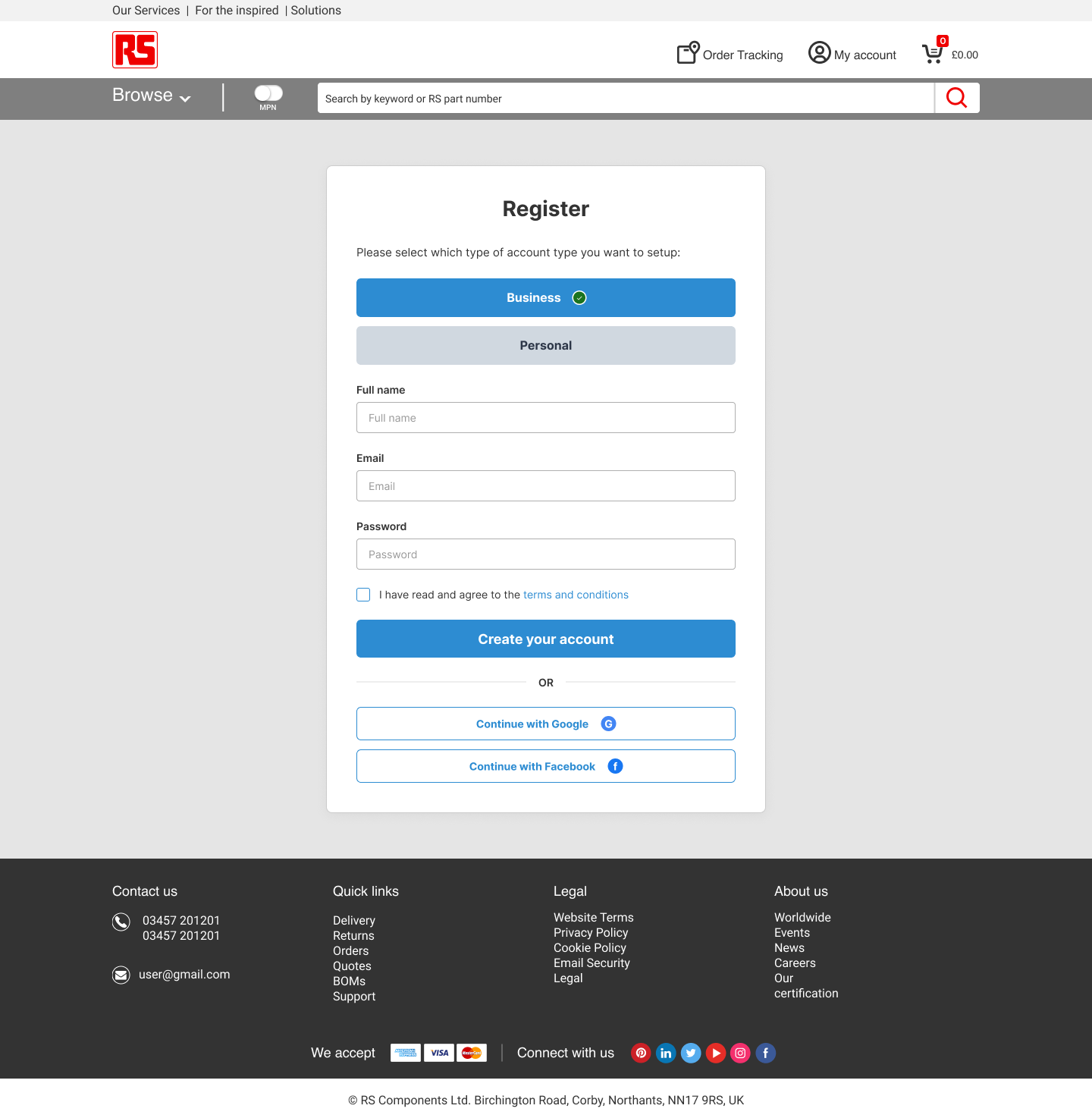
3 · Business vs Personal at the first step, with social login for both *(both — this is the two-audience decision)*
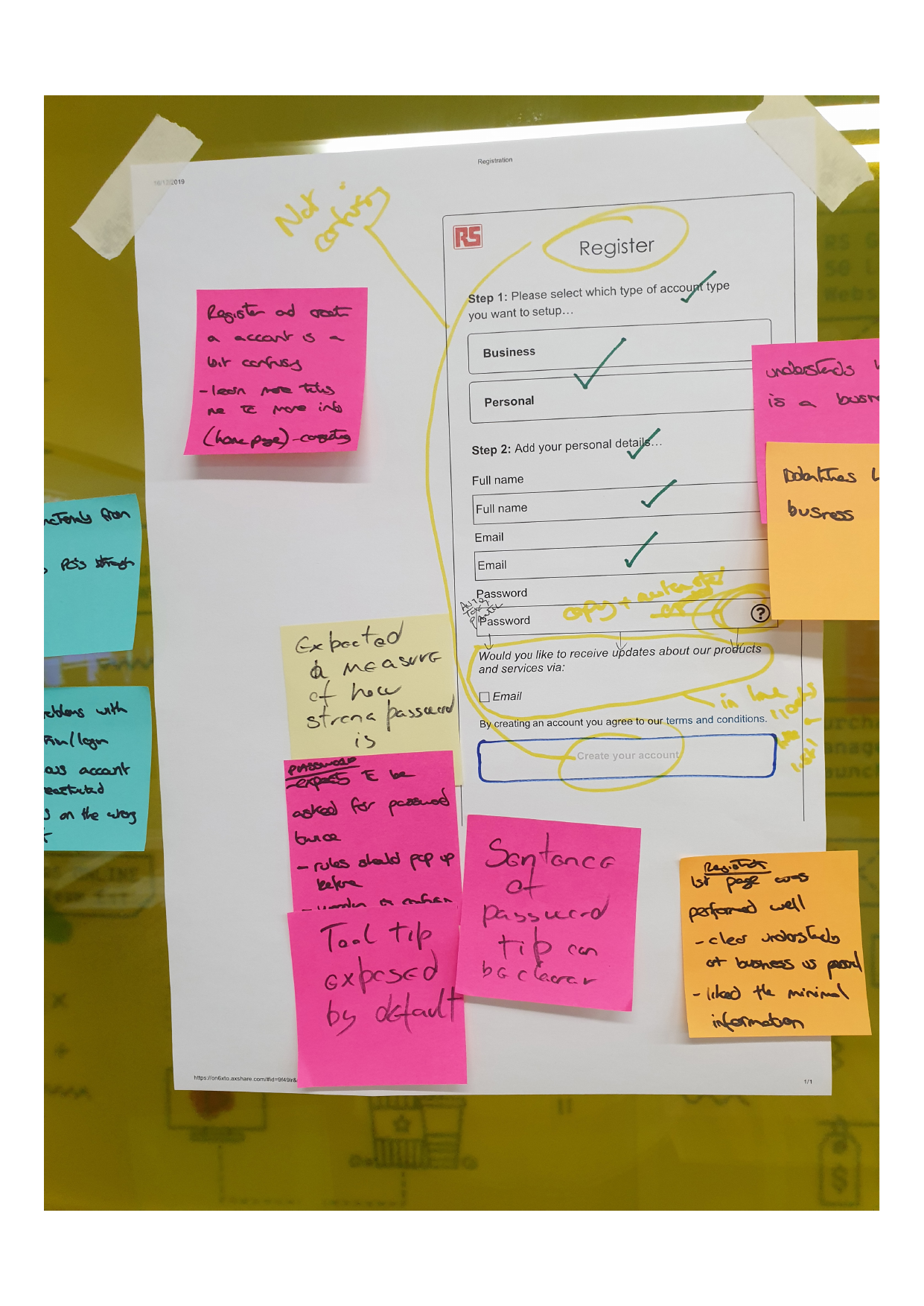
The registration flow opens with a Business vs Personal choice, and every path from there — email + password, continue-with-Google, continue-with-Facebook — is available to either. This is the pivotal design decision: it lets a consumer complete a sign-up in seconds on the terms Amazon and its peers have set, while routing a trade applicant into the fuller company-setup path they need. Same door, two very different journeys behind it. It's also the direct answer to the highest-severity trade finding: customers should be able to create logins themselves, not queue for a customer-support agent to walk them through it.
4 · Split the credit form by decision, not by field *(trade)*
Rather than one form asking for everything, break the application at its actual decision points: choose Direct Debit or Credit Invoicing first, then only show the fields that decision requires — bank details for Direct Debit, nothing extra for Invoicing.
5 · Treat the payable-person invite as identity infrastructure *(trade — bridges to Spend Control)*
Adding a payable person triggers an email inviting them to create their own verified account with the distributor — the same primitive Spend Control's team setup needs. Building this once, as a shared "invite and verify a person" capability, is the direction that avoids two teams maintaining two invite flows that drift apart.
6 · An explicit pending state, not silence *(trade)*
Every credit sketch, regardless of its structure, ends the same way: a message stating the application is being processed and a decision will arrive by email within a stated window. Where the sketches differ is what happens next — one offers to share admin rights with a colleague or add other users immediately, turning the wait into forward progress rather than a dead end. This whole pattern only applies to trade — a consumer sign-up has no pending state because there's nothing to approve.
Research & competitive analysis
Trade discovery ran on three tracks in parallel:
- Seven customer interviews — one-hour moderated sessions, mix of local and remote, with distributor customers selected for collaborative purchasing environments, good overview of their team, and across different industries.
- Three on-site customer visits — face-to-face at customer premises: Company A (portable power products, 150–200 staff, stable SME), Company B (deep-tech R&D startup, 40–50 staff, rapidly growing), Company C (calibration devices, 25+ staff, stable SME).
- Seven-plus internal interviews — customer support, accounting, customer data, health & safety.
Consumer discovery, by design, is a much lighter touch — because the requirement is already common knowledge across every consumer product on the internet, not something that needs rediscovering. The team took the frictionless-sign-up experience defined by Amazon, Google, Facebook, Apple and their peers as the constraint: consumer users will not tolerate a longer or more intrusive path than the one they already know, and if we can't match it we lose the sale to a competitor who can. That's a benchmark, not a hypothesis — it's what the design has to clear, and it's why the Business-vs-Personal split at step one is non-negotiable.
Competitive references from trade participants came up unprompted, repeatedly: Amazon Business for per-employee accounts with spending controls, purchasing rights and employee management baked in; LastPass as a workaround for surviving a multi-person shared account; Zahara for PO raising and approval workflows; and Microsoft Dynamics / ERP suites as the enterprise-scale destination companies were shopping for. Where the distributor's own web experience was mentioned as a benchmark, one participant put it plainly: "They're the best website in my industry."
How findings were rated. Every trade issue in the report carries a type (positive, observation, suggestion, hypothesis response) and, for problems, a severity — low, medium, or high — scored against the impact on the user's task rather than raw frequency. That rating scheme drives the ordering in the problem list above. The consumer finding is scored the same way but against a different reference: not "how often does this happen in an interview" but "how far does this fall short of a competitor experience the user will use next."
Interviews
Seven trade participants across seven industries — every moderated interview in this project sat on the trade side of the line. Each is summarised here by the pattern their workflow reveals; the point isn't the individual, it's what recurs across them.
- Participant 1 — Production Manager, fresh-food manufacturer (19K employees, 700 on site). Places one order per requisitioner so he can reference each individual under "Your order number." Runs two budgets (factory, projects) and switches between them per order. Receives requests by email — screenshots ~60% of the time, distributor part numbers ~40%.
- Participant 2 — Buyer, government design & install team. Logs in twice a day for 10–60 minutes. Six buyers, six logins. Runs ~12 projects in parallel; each project has a project manager who collects requisitions and approves POs before the buyer places anything. High-value orders get a PO and pay by invoice; low-value pay by card.
- Participant 3 — Technical buyer, paper-bag manufacturer (300 on site). Shares a single login and basket with a co-buyer sitting next to him — synchronises verbally. Uses the same internal PO number for every order across the whole week, then attributes items to requisitioners in the internal system.
- Participant 4 — Build supervisor, bespoke lighting and large-scale event installations. Two buyers share one login for two different departments; baskets accidentally mix. Requisitions arrive as scraps of paper, verbal, or emails. Distributes deliveries from memory. Boss watches spend through the same login.
- Participant 5 — Store manager / buyer, pork-pie plant (500 on site). Splits across five cost centres (general engineering, Bakery 2, Bakery 3, Production, Pallet repairs). Manually writes requisitioner names on printed POs and onto the delivery boxes. Can't copy/paste between their internal stock system and the distributor — retypes everything.
- Participant 6 — Project administrator / buyer, sandwich plant (300 on site). References products against ~40 internal codes for budget purposes. Uses Google to search the distributor's products because it's faster than the distributor's own search. Gets logged out constantly.
- Participant 7 — Technical support manager, TV broadcast (700 on site). Every engineer on his team is also a buyer, on the same shared login, so the team can see each other's orders, sync, and pick up each other's PO numbers and deliveries.
On-site visits repeated the same pattern at company scale. Company A funnels three purchasing managers through one manager's personal login and can't tell which engineer added what — session timeouts merge baskets and re-order items that were already bought. Company B uses LastPass to survive a shared login and Zahara to layer approvals on top; they are actively shopping for a specialist purchasing system. Company C funnels every order through one production manager because they have no way to attribute spend otherwise, and is looking at Microsoft Dynamics as the answer.
Internal interviews with customer support and accounting surface the downstream cost. Support fields recurring calls to: create logins step-by-step over the phone, provide invoice copies to accounts departments who don't have a login, and give track-and-trace links to finance because customers forget to check deliveries in on their side. Accounting flags orders arriving with no reference at all, or with mistyped budget codes, as the single biggest source of friction on their side.
No consumer participants were interviewed as part of this study. That's a deliberate scoping decision, not an oversight: the consumer sign-up requirement was set by benchmark against Amazon, Google, Facebook and equivalent, on the basis that reinterviewing consumers about a well-established pattern would tell us less than measuring the current experience against the pattern directly. A round of testing the Personal path against those benchmarks is called out as a next step further down.
Affinity mapping & key findings
Clustering the trade findings across the interview set, the visits, and the internal interviews, four themes hold across every trade participant — with a fifth theme drawn from the consumer benchmark sitting alongside.
1 · Anonymity is the root cause, not a symptom *(trade)*
The shared login and lack of per-person identity is what forces every downstream workaround: manual references, printed POs annotated by hand, one-checkout-per-requisitioner, distribution from memory. Fix identity and most of the other frictions collapse.
2 · Different roles need different permissions on the same account *(trade)*
Accounts, requisitioners, engineers, approvers, and leadership are all trying to use one login because there is no way to scope it. That's the direct handshake with Spend Control's role model — the two projects are answering halves of the same question.
3 · Companies organise by groups; the product forced them to organise by orders *(trade)*
Every participant grouped their world by projects, budgets, time periods, teams, locations, or product categories — and individuals belong to more than one group at once. The distributor had no primitive for any of that.
4 · The best answer to reference-code entry is not to type it *(trade)*
Cost codes, project names, requisitioner names — all currently manual, all a top source of accounting friction. Setting them up once, at the account level, and letting them attach automatically to orders and invoices, is the pattern that shows up across every participant's workaround.
5 · Consumer expectation is set outside our product, and beats every internal argument *(consumer benchmark)*
A consumer's tolerance for sign-up friction was set by the last product they used, not by anything we design. Every extra field, every extra tap, every wait for a verification email that could have been a Google click, moves them closer to closing the tab. This is not a preference we can debate internally — it's a competitive floor set by Amazon and its peers, and everything on the Personal path has to sit above it.
Every workaround in the interview set — printed POs annotated by hand, one checkout per requisitioner, LastPass over the top of a shared login — is a trade customer paying for the absence of identity on their own account. Every consumer bounce is the mirror image: someone silently paying us the compliment of trying, then leaving because we made them wait.
Personas
Roles that recurred across the participant set and internal interviews, in rough order of how often they showed up. The trade personas are drawn from the interviews; the consumer persona is drawn from competitive benchmark, since no consumer participants were interviewed in this study.
Production Manager *(trade)*
Oversees a production line, machines, staff. Buys for light maintenance, repairs, and tools. Directly represented in the interview set (Participant 1). Typical first buyer on a business account.
Buyer / Store Manager *(trade)*
Dedicated purchasing role — receives requisitions, prices baskets, converts to POs, checks in deliveries, reconciles invoices. Represented across most of the interview set (Participants 2–6). Frequently one of two or three sharing a single login.
Project Manager *(trade)*
Collects requisitions from a team, passes them to the buyer, approves POs, needs visibility of past orders, tracks delayed deliveries, chases invoices and payments. Explicitly present in Participant 2's workflow; implicitly in most others.
Requisitioner / Engineer *(trade)*
Specifies what to buy but often doesn't check out. Frequently operates as a guest, sends requests by email with screenshots or part numbers. In some setups (Participant 7's team), every engineer is also a buyer sharing the same login.
Accounts *(trade)*
Needs invoice copies and reference codes on every order. The most consistent complainant in the internal interviews — anonymous orders and mistyped budget codes are their number-one friction with the distributor.
Health & Safety Manager *(trade)*
Present in industrial complexes; estimated ~80% of the distributor's trade customer companies. Buys all H&S / PPE products, oversees compliance, trains personnel. Often unaware that the distributor stocks these ranges — an adjacent opportunity flagged by internal interviews rather than a primary Identity persona.
Consumer buyer *(consumer — benchmark)*
One person, buying for themselves — a hobbyist, a maker, a student, a home-office worker. No purchase order, no cost centre, no colleagues to coordinate with. Uses Amazon, Google, Facebook and Apple sign-in everywhere, and treats a sign-up longer than about thirty seconds as a signal that this site isn't set up for people like them. Doesn't complain; just leaves. The single biggest risk in serving this persona badly is that we never know we lost them.
Problem statements
Restated as points of view — one per trade role, one for the consumer, plus one for the system.
- The trade applicant (future Admin). I need to get my company set up with the distributor quickly, but the credit application front-loads five trust decisions at once — payment method, bank details, a second contact — before I've decided any of them matter to me yet.
- The trade buyer / requisitioner. I need every order on our account to carry an individual's name and a budget reference, but the only way to do that today is to run one checkout per person or type it manually into every field — and my colleagues and I are all sharing one login anyway.
- The payable person / invited team member. I need to know why I'm being asked to create an account I didn't initiate, but the invite email doesn't carry enough context from the application that triggered it.
- Trade Accounts. I need to know which budget owns every invoice, but a large share of orders arrive with no reference or a mistyped code, and I have no login of my own to pull invoice copies without calling customer support.
- The consumer. I just want to buy one part. Every other site I use lets me start with a Google click, and if this one is going to make me fill in a company form or wait for an email I haven't opened yet, I'll try the next result on the search page instead.
- System. We need one consistent model of "a verified person on this account," but we currently have two invite flows — credit's payable person and Spend Control's team member — built by two workstreams that never compared notes; and we need to serve two very different audiences through the same front door without making either compromise for the other.
Ideas & iterations
Two parallel workstreams: the credit-application ideation (four competing sketched concepts, trade-only) and the wider onboarding flow that was designed out to v2.2 alongside it (where the two-audience split is decided at step one).
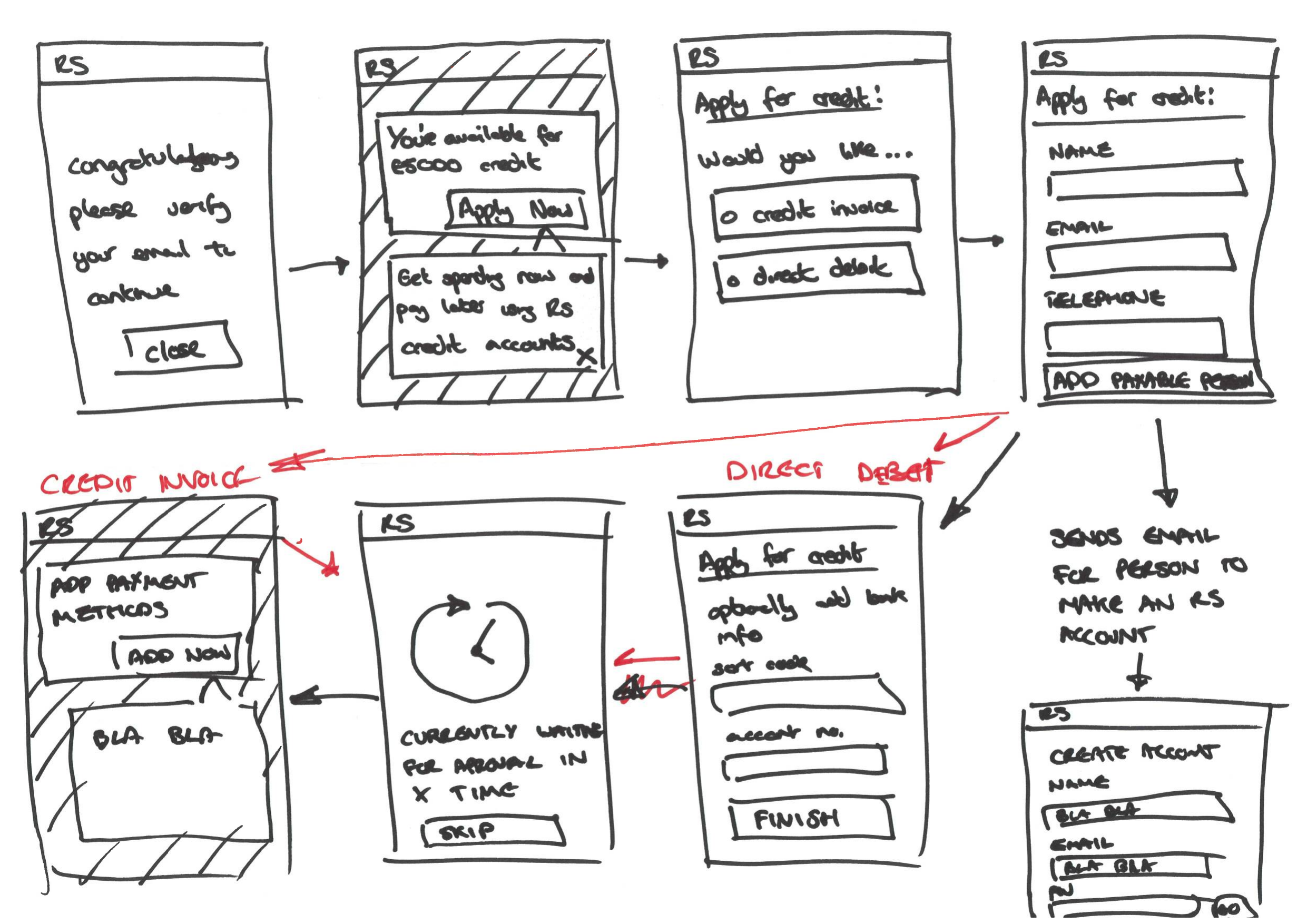
Credit-application sketches — four bets, one session *(trade)*
| Concept | Core idea |
|---|---|
| Linear application | Verify → choose payment method → single form → bank details if applicable → pending state. The most direct path, and the least forgiving of a hesitant applicant. |
| Progressive dashboard | A "My Company" tile grid — Credit, Addresses, Users — unlocking and reporting percentage-complete as each task finishes. The direction whose logic shows up in the Company dashboard that shipped as part of Basic Process v2.2. |
| Explicit step-count | A stated "5 steps" (recommended) against a "9 steps" alternative, an "add contact" step with an on-screen invitation-sent confirmation, and a closing message committing to a response window. |
| Consolidated form | One screen carrying value-proposition copy, an invoice/direct-debit toggle, a same-details shortcut, and a review-before-submit step — followed by an explicit invitation to add more people immediately after submitting. |
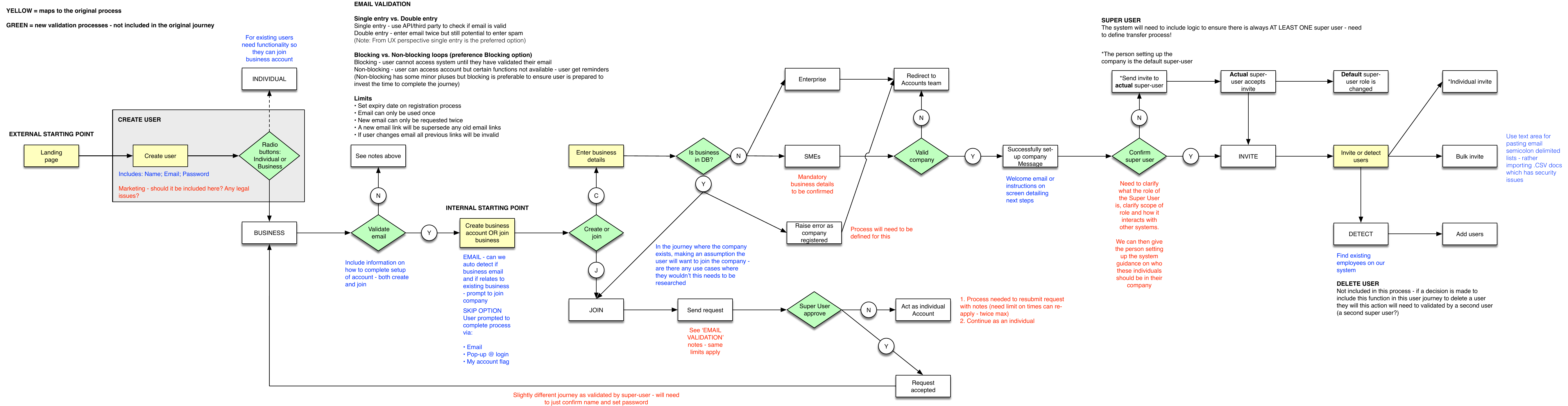
Basic Process v2.2 — where the two audiences diverge *(both)*
Where the credit sketches stayed at ideation, the wider registration flow moved forward through design iterations to a v2.2 that puts the two-audience split at the very first step: a Business vs Personal choice, immediately followed by email / Google / Facebook registration for either path. From that fork, the trade path routes through Join-existing vs Create-new business branching (Join uses Sold-to / Ship-to number + first 15 characters of company name), a new-business form covering registered name, address, telephone, company registration and VAT numbers, and — after email verification — a Company dashboard exposing Manage users, Trade Credit, Addresses, Payment, Spend Control, and Company details as first-class controls. The consumer path, by contrast, ends after email verification: no dashboard, no company setup, no credit application, just an account they can start buying with.
FIGURE — IDENTITY SKETCH SESSION 2, 9 JAN
User journeys
The end-to-end trade journey that emerged from the interview synthesis has four stages: Requisition → Prepare & submit order → Delivery & distribution → Payment & invoices. Almost every finding in the report attaches to one of these four; the four sketches and the trade half of Basic Process v2.2 are all attempts to give those stages a home inside the product.
- Requisition. Requests arrive verbally, on paper, by email (with screenshots or part numbers), as Excel or Word forms, from internal systems, or via a joint shared basket. Buyers convert them manually into a basket.
- Prepare & submit order. Buyer prices the basket, converts to an internal PO, relates each product to a budget / project / individual (via internal system, hand-written notes, or memory), gets approval, and checks out — attaching a reference under "Your order number" if they remember.
- Delivery & distribution. Buyer tracks delivery (usually via an internal system rather than the distributor), reconciles items against the order and delivery note, checks the delivery in, and distributes to individuals — often by writing names on the boxes.
- Payment & invoices. Accounts chases invoice copies (often via a customer-support call because they have no login), reconciles the invoice against the checked-in order, and identifies which budget owns the spend — again from the manual reference typed in at checkout.
The consumer journey is deliberately much shorter: Pick a sign-in method → verify email (or trust the social provider) → buy. No requisition, no cost centre, no reconciliation. The whole point is that a consumer never enters the four-stage trade journey at all; if they do, we've failed them. Basic Process v2.2's Business-vs-Personal choice is what keeps those two journeys cleanly separated from the very first click.
FIGURE — ONBOARDING USER JOURNEY, VERSION 1.0
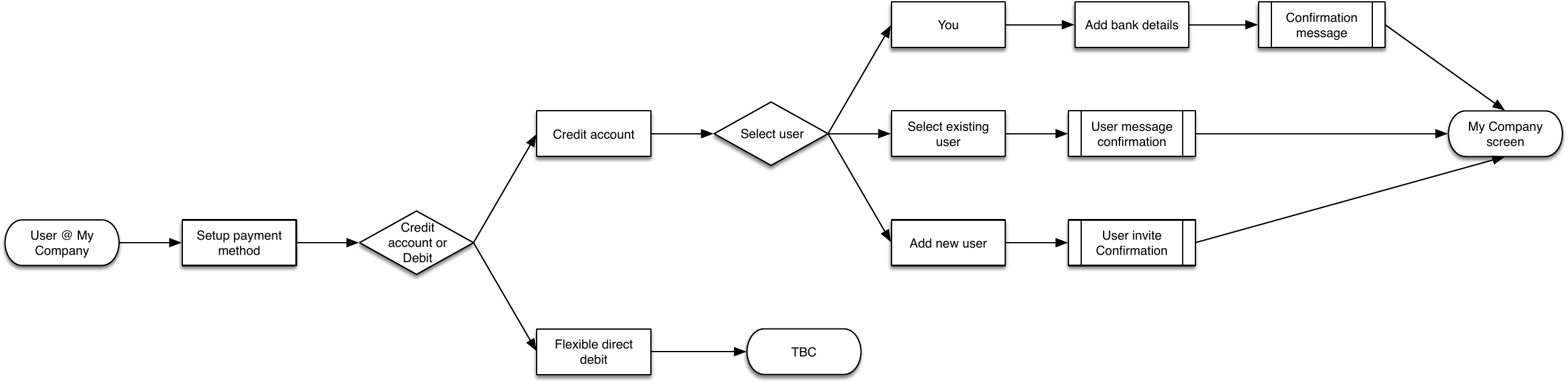
FIGURE — IDENTITY PROJECT, VERSION 1.2
Prototypes & feedback
The four credit-application concepts stayed as hand-drawn sketches — comparable to each other, not yet in front of participants. The wider onboarding flow moved further: Basic Process v2.2 is a designed set of screens covering registration (Business / Personal, email / Google / Facebook), business type (Join existing / Create new), business details, email confirmation, and the Company dashboard.
What v2.2 does not yet have is the same kind of moderated participant testing on either audience that Spend Control later ran across three markets. The right next step for the trade path is putting v2.2 in front of participants matching the trade persona set above and letting the credit-form choice fall out of what they can and can't complete. The right next step for the consumer path is a much shorter benchmark test: time the current Personal-side sign-up against Amazon, Google-continue and Facebook-continue on the same tasks, and treat any gap as a defect to fix — not a research finding to debate.
FIGURE — BASIC PROCESS VER 2.2, FEEDBACK SESSION, 16 DEC
Next steps
Where this stops, and what it would need to become a shipped flow — separated by audience so neither gets lost behind the other.
- Trade — test Basic Process v2.2 with the persona set from the interviews. The research is done; the designed flow exists. The gap is a moderated round of participant testing to validate v2.2 end-to-end and let the credit-form choice fall out of that.
- Consumer — benchmark-test the Personal path against Amazon, Google-continue and Facebook-continue. Same task (create an account, be ready to buy) on each; measure elapsed time, taps, and drop-off. Any gap against the benchmarks is a defect, not a nice-to-have — the whole reason for the Personal path is that we don't lose the sale to a competitor who's already at that bar.
- Reconcile "payable person" with Spend Control's "team member." Two invite flows solving the same underlying problem should not exist independently — this is the most concrete unification opportunity in the whole project, and it lives on the trade side.
- Commit to a real approval-time figure for trade credit, and be consistent about stating it, rather than leaving "X time" as a placeholder across every sketch.
- Ship the Company dashboard primitives — Manage users, Spend Control, Addresses, Payment — as the identity home the trade research asked for, and let the credit-form decision inherit that context rather than starting from a blank form.
- Address the highest-severity trade findings first: self-service login creation, role-scoped permissions, in-product collaboration between logins, and the ability to group orders by project / budget / team.
If I were picking one to unify the two workstreams, it's the third. Reconciling the invite mechanism is the one change that would make both Identity and Spend Control simpler at once, rather than trading one team's complexity for another's. If I were picking one to protect revenue at the top of the funnel, it's the second — a benchmark gap on the consumer sign-up is a leak we are currently not measuring.
What I would take to the next problem
Reading this alongside the Spend Control case study is the more interesting exercise than reading either alone. Spend Control's strongest finding — that authority is individual, not group-wide — only matters once a specific individual reliably exists on the account. This project is where that individual first gets attached to the business relationship, and the trade research kept pointing at the same root cause under every symptom: anonymity on a shared login is what forces every workaround the interview set catalogued.
The lesson isn't that either team did anything wrong. It's that "invite a person" is a primitive that shows up in more places than any single workstream's scope suggests, and the earlier you notice that, the less rework two teams end up doing on the same problem independently.
The second, quieter lesson: research severity ratings are only useful if the design work actually respects them. The interim report is unusually clear about which trade findings are severe / high, which are medium, and which are low; keeping that ranking visible in the case study — rather than treating every finding as equally weighted — is part of what makes the recommendations arguable rather than just a wishlist.
The third and biggest lesson is the two-audiences-one-door problem itself. A product that starts in one market and grows into another — trade first, consumer second, or the other way around — usually keeps the original audience's mental model in the shared entry points long after that stops being fair to the new arrivals. The design cost of serving both without asking one to compromise for the other is a Business-vs-Personal decision at the very first step, held ruthlessly through everything downstream. Get that fork wrong and you lose whichever audience was added later — silently, in most cases, because they never register a complaint. They just try a competitor instead.